Friday, February 20, 2009

One happy welder

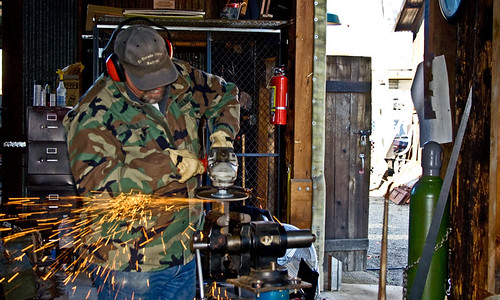
"That piece there makes me the happiest in the whole project. It fit in so nice," said welder Wayne Thorley today on the installation of the rear crown panel on the Diamond and Caldor Railbus No. 10.

Wayne estimates one more day and "we're done with the welding." The railbus project team (Wayne, Steve Karoly and Keith Berry) still need to trim out the side windows, trim out the crown panel and mount the handrail mounting brackets.

Thursday, February 12, 2009

Alright!

"Alright!" exclaimed Wayne Thorley today.

The wall panel finally fit after 30 minutes of wrangling and grinding. Wayne, lead welder on the railbus project, and Keith Berry first tried to trim a 3/16-inch strip off the 29- by 15-inch panel with the band saw.

Missing and dull teeth made the job precarious at best. The thought of a shattering blade forced them to plan B.

Wayne reverted to the best way he knew how -- to grind the metal strip off with a heavy 7-inch grinder.

Saturday, February 07, 2009

Ottawa drag saw

Since last August, small engine expert Mark Bruto has steadily restored most of the hit-n-miss engines in collection of the El Dorado County Historical Museum. Here he works on the 4-horsepower Ottawa engine for the drag saw.

Mark originally came to the museum last August to peruse the yard sale. He now heads the small engine department for the museum as a volunteer. Since that time, he has rebuilt seven engines in the museum collection.

Local contractor John Rodgers rips a beam from a larger timber. The Ottawa engine is mounted between two such beams. They also support the drag saw mechanism and form a set of handles on the forward end.

John's next task was to notch out a pocket for the engine (not visible), fashion handles and mount the hardware for the saw. Here John measures the location for the mounting bolts with guidance from Mark. Jacob Karoly then helped John paint linseed oil on the beams.

Almost ready ...

Here's the promised photograph of the middle eccentric to the Diamond and Caldor No. 4 Shay. Although it's a week late (I forgot my camera last Saturday), the timing couldn't be better.

When asked how far along his machine work was on the eccentric, lead machinist Sam Thompson said that he was making the last cut this morning. As I write, Sam is cutting a few hundredths off the rear facing.

The eccentric will be ready to mound in the crankshaft, "providing it mounts okay." It may need a little file work to make it fit, said Sam.

His next project is to fit and mount the eccentric on the crankshaft. After that's done, Sam said that he'd probably work on the line shafts before moving onto valves.

Friday, February 06, 2009

An apple a day ...

As they say, "An apple a day keeps the doctor away." Barsotti Juice Company, one of dozens of Apple Hill growers in Camino, California, has spread its medicine around over the past three to four years.

The company, a family-owned operation that grows apples, pears and grapes and produces a line of fresh-squeezed fruit juices, has graciously donated several hundred pounds of scrap steel to the El Dorado Western Railway last month. In the past, the company has donated pallets and numerous fixtures for the engine house.

The railroad will use the steel in its renovation of several key pieces of rolling stock for the El Dorado Narrow Gauge Railroad Park in the Township of El Dorado. The donation will allow the railroad to shift its valuable financial resources toward the purchase of materials for the renovation of the Diamond and Caldor Shay No. 4 and Railbus No. 10.

Board member Bill Rodgers coordinated the donation for the railroad. Bill is a part-time maintenance employee at the Barsotti bottling plant.

Monday, January 26, 2009

Now that spring's over ...

Outdoor work on the Diamond and Caldor Railbus No. 10 came to an abrupt halt Friday. A series of winter storms that slammed into the engine house made outdoor welding unsafe. The crew turned to other projects.

So, after two weeks of productive spring-like weather, all work moved indoors. Outside of some shop cleanup and design work, the two machinists were the most productive crewmen.

Sam Thompson steadily carves the middle eccentric for the Diamond and Caldor Shay No. 4 out of a large piece of cast iron. This photo, taken on Saturday, January 10, 2009, shows Sam's early progress. As of this past Saturday, the eccentric was starting to take shape. I'll post a photograph next week.

Saturday, January 17, 2009

Grinding away


Grinding away, originally uploaded by SeabeeCook.

By my account, Keith Berry, Wayne Thorley and Steve Karoly have put in about 72 man-hours into the restoration of the Diamond and Caldor Railbus No. 10 since the first of the year. We have worked each Friday and Saturday since January 3.

Since Wayne took today off, Keith and I are working on other projects this morning.

As of this morning, we have completed the frame for the railbus and have completely re-built the rear coupler pocket. The rear wall to the body was completely framed in over the past four work sessions.

Yesterday, Keith and Wayne fabricated the pocket for the backup light and installed five cross-braces under the front deck on either side of the engine housing. One brace on the engineer's side will support the battery box. The two braces on the fireman's side will support the airtank.

Although Keith, Wayne and Steve currently make up the railbus team, other volunteers have contributed toward the railbus. They include:

  • Bill Rodgers and Mark Bruto repaired the MIG welder last Saturday. After mentioning about the welder 's demise on Friday, January 9, Keith and I though that we were going to have to transport it to Sacramento for repair. Bill and Mark stepped in Saturday and discovered the problem was a stuck relay switch.
  • Marcus Hodge is currently fabricating the battery box in his shop at home. When he completes that project, Marcus will take another project home to work on.
  • Jacob Karoly has served in a key role as Keith's helper for two Saturdays now. He will continue to work every other Saturday.
  • Dale Mace did the original design work on the coupler pocket. Dale has not been able to attend recent Saturday work sessions.
  • Ed Cuhna researched the make and model of the Wakasha engine. This is significant because two years ago we though it was a Stewart.
  • Now that we know the origin of the engine, we will be able to locate parts, etc., when Doug Youngberg re-builds it in his home in Oregon this spring and summer.
  • Keith Berry located and purchased a diesel locomotive ditch light for use as the backup light.
  • Keith Berry and Alterto Weiss built the brakeman's footboards last summer.

In the top photograph, volunteer Steve levels a piece of steel tubing with the power grinder inside the engine house. Keith fits the battery box brace in the second photograph.