Lead machinist Sam Thompson continues rebuilding the valves on the Diamond and Caldor No. 4 Shay locomotive. I'll have more to report on the process soon. Sam continues to work most Saturdays at the engine house.
 Last week the mid-week crew re-installed the rear truck under the Diamond and Caldor Railbus No. 10. They them removed the front truck in order to begin the rehabilitation process.

 Work on the rear truck to the Diamond and Caldor Railbus No. 10 is moving along. Since removing the truck in mid-September. Here's the work that the crew has done in the past three weeks:
 I stopped by the engine house on Wednesday to view progress on the Diamond and Caldor Railbus No. 4. This was my first visit since I went back to work on October 13.
  Ed Cunha uses a sledge hammer to straighted the leading edge of the cab roof. The roof was damaged at the point where the line for the air horn traveled up to the roof. We don't know when or where the roof was damaged. It's been that way as long as anyone can remember.
 Mark Bruto (left), Sam Thompson and Keith Berry guide the rear truck out from under the railbus. The crew will renovate the rear truck first before proceeding to the front truck.
 Mark demonstrates how to remove a hydraulic jack when it's stuck between the cribbing and link-in-pin coupler on the railbus!
 Last Saturday, Dale Mace used a compass-like guide to cut center body plates from a sheet of three-quarter-inch steel plate.
 I asked Dale to show me how the pieces would work. He took me over to the truck and placed the two plates on the bolster. Dale later drilled a large hole in the center of the plates. The center pin will pass through the hole when the crew assembles the truck.
 The original bearing to the Diamond & Caldor railbus flat-bed trailer. One ball bearing is visible in the center.
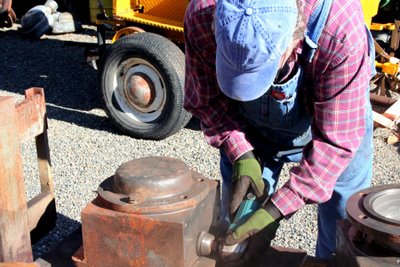
Much of the work in the railroad is dusty, tedious and time consuming. Here, Ken Romine cleans rust off of the journal boxes to Arnold Z, our Plymouth locomotive. Ken and his son, Scott, will paint the boxes today.
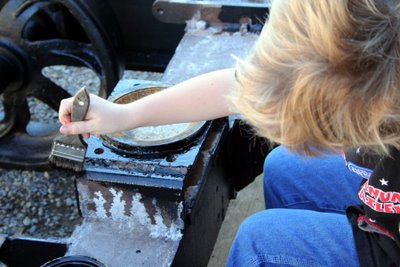 Eight-year old Logan paints the topside of one of the Railbus trailer trucks.
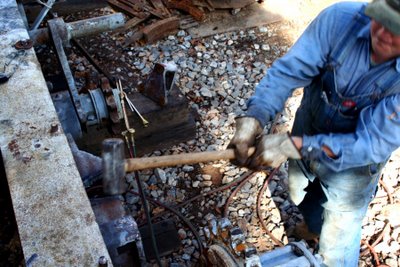 Locomotive engineer Garrett Augustus uses a large sledge hammer to forcibly remove a spring hander from Arnold Z, our Plymouth locomotive.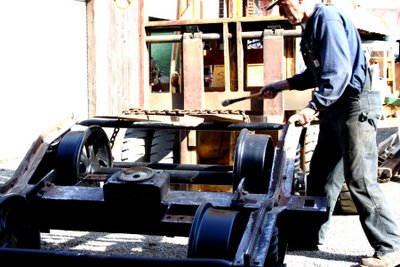
EDWRF President Eric Stohl (not visible) used the forklift to flip this truck. Treasurer Bill Rodgers hammers the chains off of the forks.
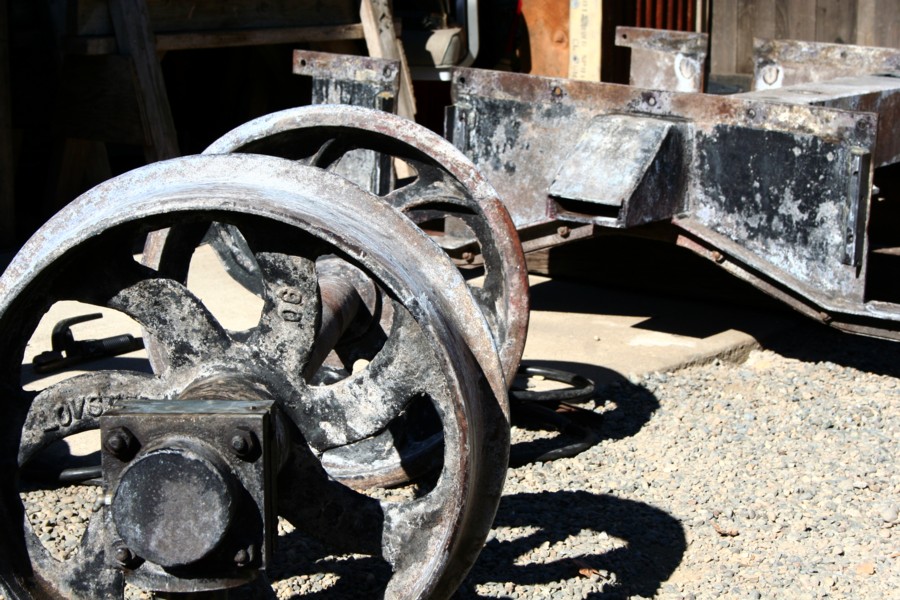 The first truck assembly to the Railbus trailer is now completely disassembled. Welder Dale Mace and president Eric Stohl removed both wheel sets this morning.