Showing posts with label Plymouth locomotive. Show all posts

Sunday, May 08, 2011

Brake check

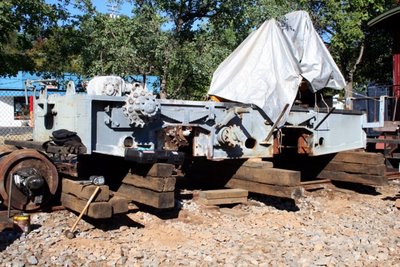
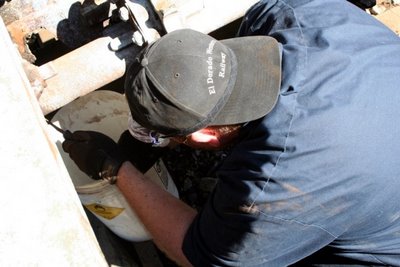
On Friday the crew exercised the bearings on the flatcar and checked the brake lines. The railroad acquired the flatcar, numbered as the El Dorado Western Railroad MW 1003, from the California State Railroad Museum via the Folsom, El Dorado and Sacramento Historical Railroad Association.

The flatcar will be used for maintenance of way duties for now. Ultimately, crews will convert it into a passenger car. It will be renumbered at that time.

EDWR general manager Keith Berry gets ready to step into the red zone to couple the flatcar to the El Dorado Western Railroad No. 1 for the first time.

The Plymouth and flatcar on the tracks beside Oriental Street in the historic town of El Dorado.

Friday, December 24, 2010

EDWR No. 1 on YouTube


Brett Soto, El Dorado Western engineer trainee, heads to Hagen's Crossing on the first run day for the 1952 Plymouth JDT 18-ton locomotive. Number 1 is the first Locomotive on the Placerville Branch of the Sacramento Valley Railroad in more than 20 years.

Plymouth loco run day at El Dorado

There's nothing more exciting than to wake up Christmas morning and find a HO-scale train under the tree. All you want to do is piece the track segments together, plug in the transformer and run the five-car train in a circle for hours on end. It's a holiday ritual that's been practiced in millions of American homes over the past century.

Last Saturday morning the town of El Dorado woke up and found a full size Plymouth locomotive under the oak trees. The banner on the engine housing proclaimed, "Merry Christmas to El Dorado, CA."

It's the gift of the El Dorado Western Railway to the historic town of El Dorado, a town that once served as an important stop on the Southern Pacific Placerville Branch rail line. Two long blasts on the whistle indicated that the railroad had returned to El Dorado.

Steven Karoly takes his turn at operating the No. 1. The crew ran the El Dorado Western Railway No. 1 up and down the rail this afternoon. The 18-ton Plymouth locomotive was donated to the railway on Friday, December 17, 2010 by the CertainTeed Corporation in Chowchilla, California.

The Plymouth approaches Hagen's Crossing at Oriental Drive. The banner over the radiator thanks three companies for their assistance in the donation of the Plymouth locomotive to the railway. They include the CertainTeed Corporation for its donation of the engine, Diamond Crane of Diamond Springs for lifting the locomotive onto the track and Bordges Timber of El Dorado for transporting the engine to El Dorado.

Cal Jessiman relaxes for a moment after completing the first leg of his run to Hagen's Crossing.

Saturday, February 28, 2009

Starting to look like a locomotive

Arnold Z, the El Dorado Western Railway's only diesel-powered locomotive, has sat in a state of disassembly for about three years. The crew started preparing her for renovation in early spring 2006.

It was an exciting time. Except for Sam Thompson's valve-facing project, there was little need for a crew to work on the Diamond and Caldor No. 4 Shay. Most of the immediate work had been completed. The two of the four remaining projects -- build a new middle eccentric and repair the boiler -- were beyond the expertise of most of the crew. (Sam has since finished the eccentric.)

We needed a project for the three enthusiastic volunteers who had just joined the El Dorado Western project. The tear-down proceeded quickly. The crew cut up the steel cab and set it on a pallet next to the machine shop. They then removed the wheel sets, journal boxes and leaf springs. You can view the project’s early progress by typing the keyword "Plymouth" in the search box above.

We thought the locomotive could be operational within a year or so. By the spring of 2007 the Arnold crew had disbanded due to things beyond their control. Two of the three crewmen (a father and son) both had to start working Saturdays. Without the two strong backs, the third crewman turned to other projects.

The project soon faltered. The disassembled Plymouth locomotive sat in the museum yard along the fence for two years. Except for a occasional paint job, we focused our energies on other pressing projects.

Last week the crew has turned its attention toward Arnold. The crew built a new cab and remounted the radiator and engine hood in response to a recent effort to clean up the museum yard. The team consisted of John Rodgers, project lead for the cab, Bill Rodgers, Keith Berry, Steve Karoly and Jacob Karoly.

Keith holds the plywood sheet while John cuts a wall panel for the new wood cab to Arnold. As a local contractor, John has volunteered his time on several key woodworking projects since last fall.

John screws one of the top plates onto the studs for the cab.

Steve helps John mount the end piece on the rafters to the cab last week. The cab was 90 percent done when the crew left at 5:30 p.m. last Saturday. John installed the windows Wednesday and worked on some of the trim.

Wayne waits for the radiator as Keith brings it forward with the forklift. Bill placed a temporary set of running boards over the gravel ground covering.

Bill guides Keith as he operates the forklift. It was a delicate operation that required Keith to raise and lower the radiator in very small increments.


Bill and Wayne guide the radiator in place as Keith drives the forklift.

Wednesday, March 12, 2008

Yard cleanup day

Saturday the crew of the El Dorado Western Railway cleaned the engine house yard. Our main purpose was to help the museum get ready for its sale of excess museum property, which is being help on Saturday, March 29, 2008 (see the link for more information on the sale).

Like many short lines, including the Diamond and Caldor Railway, we have collected an odd assortment of scrap iron and old parts in 15 years of existence. To facilitate the sale, the crew had to move railway property to a secure area. Since railway property is not for sale, we wanted to ensure that museum staff and volunteers only tag appropriate items for the sale.

All went well until about 11 a.m. when the transmission in the forklift became extremely hot. Eric Stohl, EDWRF president and forklift driver parked it and shut her down for the day.


Keith Berry, left, Steve Karoly and Bill Rodgers wrestled the three rusted drive chains to Arnold Z, the Plymouth locomotive, into a steel barrel. Keith plans to give the chains a Diesel-fuel bath. This will help break the rusted links to the point where we can clean and lubricate.

Eric prepares to move a pallet of parts for the Michigan-California Lumber Co. bobbie car. We believe the bobbie car, which the Mich-Cal once used to transport rough cut lumber across the American River gorge is the only one remaining.

Doug Youngberg, left, and Bill catch up on news on the railroad front while Eric loads the bobbie car parks on Doug's trailer. Since Doug's move to Oregon last year, he had become one of a handful of long distance volunteers. Doug plans to rebuild the bobbie car in his new machine shop.

Keith, left, and Doug discuss possible problems with the forklift. At first they though it may be a hydraulic leak. They later determined that the cause of excessive smoking and fluid loss could be a transmission seal.

Sunday, February 04, 2007

Painting Arnold Z

Keith Berry stopped by the engine house to paint a primer coat on Arnold Z. Garrett, Ken and Scott have been restoring the the Plymouth diesel switcher for about nine or 10 months. The old cab was removed last spring. Since then, the crew has removed the ballast, wheel sets, journal boxes and leaf springs. And they have been actively scraping and chipping old dirt, rust and paint from the chassis. They are at the stage where they can begin rebuilding and reconditioning the individual parts.

"This is perfect painting weather. The sun's hot," said Keith. He wanted to get it done before long-overdue rains arrive next week. The high today will be in the mid-70s today in Placerville. The current plan is to keep the body gloss black silver lettering.
Sunday, January 28, 2007

A Productive Week

The crew of the El Dorado Western Railway capped a productive week with a hearty meal yesterday. It began with the donation of 1,500 feet of rail to the railway Monday. The meal was a reward for an action-filled week.

Nine crewmen gathered at the engine house to continue work on two locomotives. The railway is currently in possession of three engines, as follows:

  • Diamond & Caldor No. 4, 2-truck Shay (CN 1896), built in 1907
  • Arnold Z, the Plymouth, switcher from Glenn Bell's West Side & Cherry Valley Railroad (possibly the No. 11 according to John Barnhill)
  • Michigan-California Lumber Co. No. 6, a 0-4-0T Porter (CN 2044), built in 1899

A fourth, the Diamond & Caldor Tally Ho No. 10 railbus, is owned by the El Dorado County Historical Museum. EDWRF Vice-President Keith Berry announced Saturday that the El Dorado County Museum Commission approved funding to restore the railbus to its original Diamond & Caldor configuration.

The commission released the initial $1,000 to purchase metal to restore the steel cab and frame. Future funds will be available to rebuild the Waukesha engine and redesign a new brake system. (I mistakenly reported the engine as a Waukesha. See this post and this one.)

The Plymouth crew of Garrett, Ken and Scott continued work on Arnold. They were able to move both wheel sets to spot where we can load them on one of the pick up trucks. Garrett has working with a few Sacramento machine shops to turn the wheels. They closed the day chipping and priming one side of the locomotive's large steel frame.

Welder Dale continued building another set of saw horses. This set will stand 4 feet above ground level. We plan to use this set to access the high points on the No. 4.

Dale also built a second chop saw stand. Since the railway has a large stock of old boiler flues, we plan to build several saw horse sets for our supporters. If interested, please contact me at my email address (Steve -at- SeabeeCook.com). President Eric Stohl has not set a donation price yet.

Sam's "Rube Goldberg" valve shaper is nearing completion after 15 months of trail and error design and construction. Sam and Bill spent Saturday installing the pneumatic controls to the shaper. We expect a test run soon.

Housekeeping work also continued. Keith vacuumed about 10 pounds of bead material from the bead blaster. He then poured a fresh 50-pound bag into the machine. His next project is to clean the brake parts to the flat car.

I have more news, including the donation of 1,500-feet of high-grade rail to the foundation. I'll post more news through the week.

Saturday, November 18, 2006

Working in the Railroad

This blog comes to you in real time ...

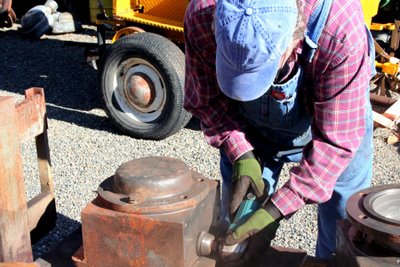
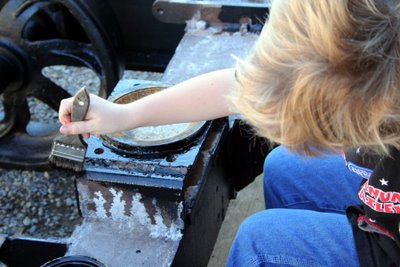
Much of the work in the railroad is dusty, tedious and time consuming. Here, Ken Romine cleans rust off of the journal boxes to Arnold Z, our Plymouth locomotive. Ken and his son, Scott, will paint the boxes today.

Eight-year old Logan paints the topside of one of the Railbus trailer trucks.
Saturday, November 04, 2006

A Whole Lot of Hammerin' Going On

There was a whole lot of hammerin' going on today at the El Dorado Western Railway engine house.

"We called them fittin' tools," said retired welder Dale Mace. The sledge hammer was used at each of his jobs to make things fit.

Dale's career that spanned more than four decades where he worked as a ranch mechanic, armored car fabricator and all-around welder.

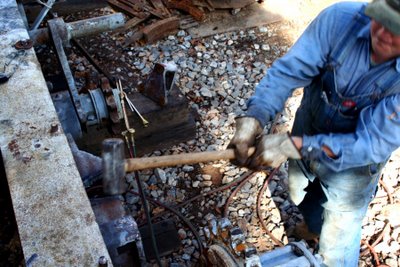
Locomotive engineer Garrett Augustus uses a large sledge hammer to forcibly remove a spring hander from Arnold Z, our Plymouth locomotive.
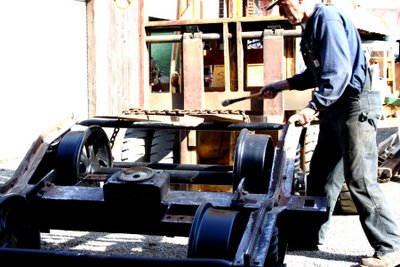
EDWRF President Eric Stohl (not visible) used the forklift to flip this truck. Treasurer Bill Rodgers hammers the chains off of the forks.

Saturday, October 28, 2006

Busting Off J-Box Wear Plates

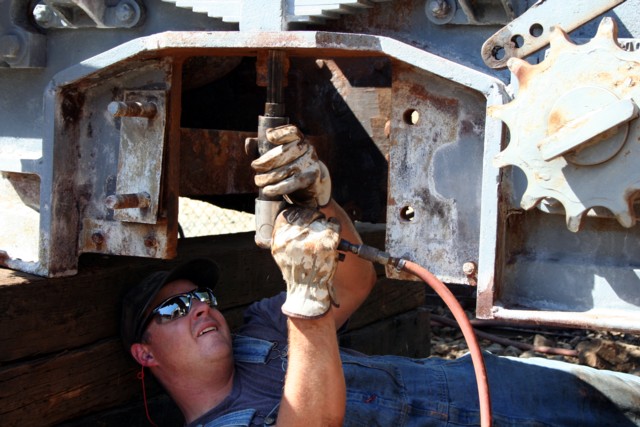
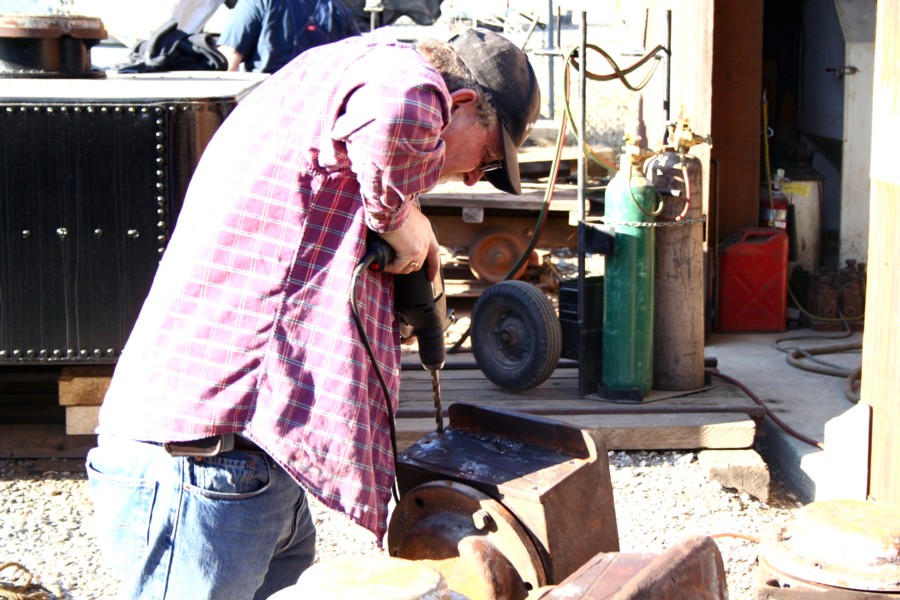
Ken Romine drilled out the hexagon-head bolts to day on all four journal boxes to Arnold Z today. Ths was a last resort attempt to remove the left- and right-hand wear plates on the boxes.

Ken is going to use the wear plates in the best condition as a pattern for new plates. He will use one plate from each side.

What made this tricky was that there was only one good left-hand wear plate. By late morning, Ken has successfully removed all wear plates from the j-boxes.

Saturday, October 14, 2006

Back to Work

The work must continue ...

Garrett Augustus returns to the dirty work of running a railroad. After the boiler committee meeting this morning, Agustus returned to his main project, which is cleaning our Plymouth locomotive, Arnold Z.
Saturday, September 09, 2006

Journal Boxes to Arnold Z

This blog comes to you in real time ...

At our last work day two weeks ago, Garrett Augustus, Ken Romine and Scott Romine finished removing the last two journal boxes from Arnold Z.

Ken and Scott took the four boxes to Performance Machines (1348 Yosemite Ave., Mantica, CA, 209.239.2000) for service.

Owner Walt charged $40 boil the bearings in acid and steam clean the boxes. The job normally costs $100.

It's the generous donation time and labor by local business that helps the El Dorado Western Railway accomplish its goal of restoring locomotives like Arnold to service.

As I write, Ken is blasting rust away with a pneumatic needle gun in the museum yard. Ken, Garrett and Scott will prime, paint and repack the bearings at future work days.

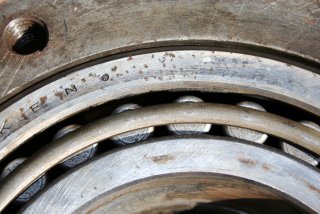
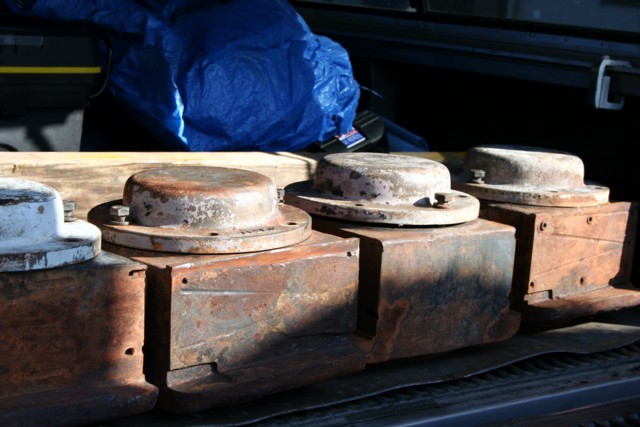
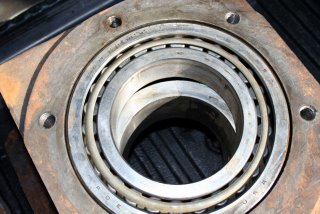
Here's a few shots of the interior of a journal box:

Sunday, August 27, 2006

Removing Arnold Z's Journal Boxes

I only had a few minutes to stop by the engine house yesterday. An adult daughter is in town and I spent the day with her.

When I walked in around 9:30 a.m., Garrett was attacking the Arnold Z with a needle gun. Sam and Bill were working on a few items in the machine shop. And Eric and Logan stripped threaded bolts from one of the trucks to the Railbus trailer.

Last weekend, nine volunteers labored on the No. 4 Shay, the Plymouth and the trailer. It was the best turnout the El Dorado Western Railway has had this summer.

Garrett, Ken and Scott removed the last two journal boxes to the Plymouth. Dale, Eric and Logan, our newest and youngest trainman, were removing the brake shoes and tumbler bar from the Railbus truck. And Sam and Bill continued in the machine shop with Sam's valve shaping tool. Keith helped where needed.

(In case you're interested, I take keep historical notes for the newsletter and the blog, in addition to being the photographer.)

Tuesday, August 15, 2006

Wheel Sets Removed From Arnold

I stopped by the engine house Saturday for the first time since I returned from vacation. My visit only lasted 1-1/2 hours. Keith and I were heading to Yerington, Nevada to pick up a 1941 Dodge military Power Wagon.

Over the work day of Saturday, August 5, 2006, Eric, Keith and Garrett removed the wheel sets for Arnold Z, the El Dorado Western Railway's Plymouth switch engine. Both wheel sets were placed behind the locomotive (to the left of the photograph).

Scott had "planned on getting those two journal boxes off" the wheel set Saturday. Several sick volunteers and other projects in progress left Scott with nothing to do but clean the Plymouth.
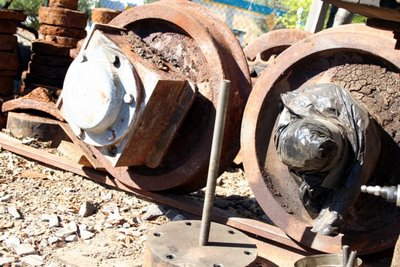
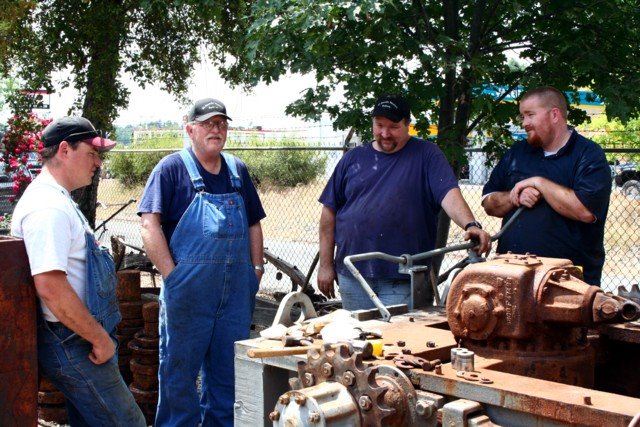
The journal box on the left. The other pair of journal boxes were removed last April. The puller sits on the ground between the wheel sets.

Saturday, May 27, 2006

Progress on Arnold

The valley crew made its long trek into the El Dorado Gold Country from Sacramento last Saturday to continue work on Arnold Z, El Dorado Western Railway's Plymouth switcher.

Garrett Augustus (left in photo), a locomotive engineer for the Sierra Northern Railroad, leads the group. Filling the Arnold team is Ken Romine (second from left) and his three sons. Sons Dave and Scott are pictured to the left. Son James didn't come up last weekend.

In addition to Garrett's obvious skills as a locomotive engineer, the Romine family brings a wealth of mechanical and wood working skills to the project. Ken and Dave are long haul truck drivers and skilled mechanics while Dave is the maintenance supervisor for a large bowling alley. James is the carpenter of the family.

We welcome the Arnold team to the El Dorado Western.

Tuesday, May 23, 2006

Quick Update

I've been busy with work and other activities. I should be able to post my weekly update on last Saturday's renovation activities tonight. The Arnold crew (Garrett, Ken, Dave and Scott) was in Saturday on one of their semimonthly renovation trecks up into the from Sacramento. Sam was in the machine shop. And Eric and Dale started work on the Railbus trailer.

I took photos as usual. I'll post several tonight. Go to the Narrow Guage Discussion Group for a discussion on the Railbus trainer.

Steven

Saturday, May 13, 2006

Milling the Drive Shafts

I stopped by the engine house this morning for a few hours. There wasn't much going on as this is the "off" weekend. In the photo Dave Spohr (left) and Eric Stohl discuss the driveshaft renovation project.

Our Plymouth crew -- Garrett with Ken and sons -- travels up from Sacramento to work on another small piece of Arnold every other weekend. They'll remove one or two of the journal bearings next Saturday.

This morning, Eric Stohl and Dale Mace were installing the final corner brace for the Shay. When I left at 11 a.m., Dale was welding the joint between the base plate and the rod. The brace project will be done once Eric and Dale install the brace.

Of the six braces, three were completely fabricated by Dale. Only three original braces were found when found when the crew started this project some 12 or 13 years ago. Dale and Eric were able to install two of the original braces without any modification. The third was modified some.

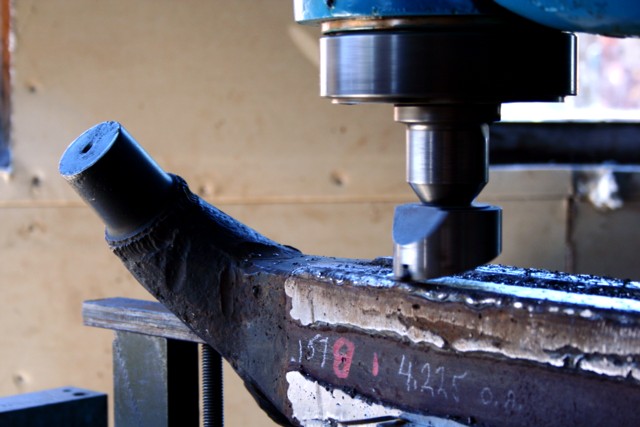
Sam Thompson continued building his valve shaper in the machine shop. Dave Spohr was milling one of the short male drive stafts at the other end of the shop (see photo to left).

The Shay geared locomotive used a line shaft to drive the right wheel on each axel set. ShayLocomotives.com describes this unique arrangement:

These line shafts were attached to square shafts through couplings. The square shafts slid into sleeve shafts, which were attached to the crankshaft through another set of couplings. The square shaft sliding freely in the sleeve shaft allowed the locomotive to take sharp curves. As the truck turned to follow the track curve, the distance between the crankshaft and the truck increased or decreased and the square shaft slid in or out while still rotating, delivering power to the truck from the pistons.

Keith Berry described the restoration process in the spring issue of the newsletter:

Dave [has been working with Sam and Dale since February to restore the male] driveshaft faces to specification. Over normal locomotive operation, surface-to-surface friction from turning and the constant presence of dirt kicked up from the ballast ground the driveshaft faces down.

Sam's challenge was to locate an arbitrary starting surface point to weld/build the contact surfaces and end up with a four-sided square drive shaft. Once established, Dale welds, and Dave mills the surfaces. Then Dale welds, and Dave again mills, and around it goes. Or in this case, square it becomes! Eventually, the shaft will reach finished specification and they'll start on the next shaft.

In the photo to the right, Dave used a fly cutter to shave 0.045-inch off the face of the shaft. Dale can only add metal to two surfaces at a time. One of the milled surfaces is used to lay the shaft level on the milling machine. The other is used as a gauge.

Dave feeds the surface being cut at a rate of 3/8-inch per minute. It takes 50 minutes to mill each surface.

Dave said Dale would ultimately add metal to edges so that he could form a true edge on the shaft. The edges take most of the punishment as the shaft slides in and out of the companion driveshaft.

Friday, April 28, 2006

Mount Slugmore

After I returned from the engine house, I glanced over at the billet pile. "Wow! They keep growing," was all I could say.

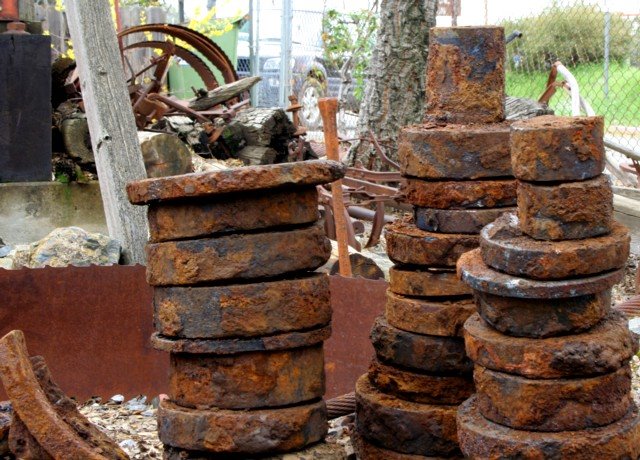
Every five minutes, the Arnold crew pulled another heavy steel slug from the shelf under Arnold's pumpkin.

Ken's description fit best: Mount Slugmore.

The Arnold crew chipped away the red clay-like layer of mud that had glued the billets to the shelf for most of the morning.

I had to learn the true purpose of these steel slugs, many about 12 inches in diameter. Keith and Garrett gave me an education.

They figured the billets were used to compensate for wheel slip. Early in Arnold's career, the Plymouth locomotive hauled salt trains from the evaporative beds to salt works in Salton, California. The extra weight increased tractive effort. If their theory holds, Arnold could haul more cars.

Any reason for the different billet sizes? No, Keith answered. The mechanics used what they had in the shop -- mostly mill ends and cut-offs.

It's amazing the things you learn on the railroad!