This history was prepared by Robert Niles for the Eldorado National Forest in 1979. The El Dorado Western Railway blog will reprint serialized portions of Mr. Nile’s report in the coming months.
The rail logging spurs progressed outward along the drainages with grade changes being held as low as possible, but could run up to as high as eight percent for short distances when necessary. The spur road beds were not ballasted as they were considered only temporary in nature and final grading and construction were left to minimal requirements to support the engines and loaded cars.
Rail ties and trestle timbers were provided from the Caldor Mill and most certainly represented a substantial board foot volume of lumber production. After all the accessible timber adjacent to the spur lines were logged out, the rails were removed for reuse on other spurs.
All the logging rails were narrow gauge, three-foot width, to coordinate rolling stock with the rest of the Diamond and Caldor railroad system. Manpower was the predominant factor in placing rails and building trestles and the use of crowbars, sledges, shovels, crosscut saws and jacks were much in evidence.
Few records were kept of the logging rail system and it would probably be easier to trace these spurs through the overgrown country side than to locate or rely on any tangible records. An examination of old maps, cutover charts and actual on-the-ground observation and knowledge, however, gives one a pretty accurate account of the location of the entire system.
Logging camp locations and their approximate dates of use were also gleaned from these few remaining charts and maps. Firsthand knowledge, interviews and observation of physical evidence of known campsites were also relied of for some camp locations.
Saturday, November 15, 2008


Sunday, November 09, 2008
Hanging around

A crewman and visitors discuss engine mechanics during a break from rides. The two-cylinder engine was only hitting on one cylinder most of the time.
The engine ran smoothly despite mechanical problems. Keith and Mark said that they would perform a compression check in the next two weeks to find out what's going on.
It was hitting on "one and a half" cylinders once the engine warmed up, said Mark.
The Camino, Placerville and Lake Tahoe Railroad donated the speeder car to the county museum sometime after it ceased operations in 1986. The standard gauge CPLT No. 4 was built by Kalamazoo.
Speeder driver

The El Dorado Western Railway, in partnership with the El Dorado County Historical Museum, hosted rides museum's track inspection car on the former Southern Pacific Placerville Branch in El Dorado, between El Dorado and Blanchard roads.
The ride gave us a chance to tell key people and organizations of our plans to build a railroad park and demonstration railroad on the site of the old SP railroad depot at El Dorado.
EDWRF president Keith Berry drives the Camino, Placerville and Lake Tahoe Railroad speeder back to the depot site. Each ride took the car 1/2-mile west toward El Dorado Road. Keith then "turned the car around" and headed to Blanchard Road, about 1-1/2 miles to the northwest. Each 3-mile ride took about 20 minutes.
Saturday, November 01, 2008
History of the California Door Company and its logging railroads #7
This history was prepared by Robert Niles for the Eldorado National Forest in 1979. The El Dorado Western Railway blog will reprint serialized portions of Mr. Nile’s report in the coming months.
The geared locomotive was originally designed and patented by an enterprising Michigan lumberman named Ephriam Shay in 1881. Shay recognized the need for a small, powerful locomotive that could be used to transport logs over steep grades, poor road beds and tight radius curves to the sawmills.
The existing rod driven locomotives were limited to gentle grades and required well ballasted road beds to withstand the pounding shock of the drive wheels, and thus were limited to well maintained, permanent mainline hauls.
The Lima Locomotive Works began manufacturing the first crude, two-truck Shay geared engines on the Shay patent and by 1888 had sold 200 to the lumber industry. At this time the Climax Manufacturing Company of Corry, Pennsylvania, brought out their Climax geared locomotive and in 1894 Charles Heisler in Erie, Pennsylvania, produced the Heisler geared locomotive.
Shay’s head start, its rugged performance and improved models, however, put it well a head of its competition. The Lima Locomotive Works produced 2,761 geared Shay locomotives until it ended their production in 1945, and the argument over which was the best geared locomotive had been won decisively by the Shay.
The Diamond and Caldor Railroad utilized 9 Shay locomotives and the one Baldwin 2-4-2T Saddle Tank Rod Locomotive at various times during their 50 years of railroad operations.
The transition to railroad logging progressed rapidly after 1904 with construction of logging spurs extending from Caldor northwest into the Steely Forks and south and east into the Middle Fork of the Consumnes River drainages.
Road alignments were laid out and construction crews brought the road beds to grade with horse drawn “Fresno” scrapers. Black powder was utilized for blasting loose stumps and rock formations. Because fill material volume was difficult to obtain, extensive use of trestles were used to cross even minor drainages.
The geared locomotive was originally designed and patented by an enterprising Michigan lumberman named Ephriam Shay in 1881. Shay recognized the need for a small, powerful locomotive that could be used to transport logs over steep grades, poor road beds and tight radius curves to the sawmills.
The existing rod driven locomotives were limited to gentle grades and required well ballasted road beds to withstand the pounding shock of the drive wheels, and thus were limited to well maintained, permanent mainline hauls.
The Lima Locomotive Works began manufacturing the first crude, two-truck Shay geared engines on the Shay patent and by 1888 had sold 200 to the lumber industry. At this time the Climax Manufacturing Company of Corry, Pennsylvania, brought out their Climax geared locomotive and in 1894 Charles Heisler in Erie, Pennsylvania, produced the Heisler geared locomotive.
Shay’s head start, its rugged performance and improved models, however, put it well a head of its competition. The Lima Locomotive Works produced 2,761 geared Shay locomotives until it ended their production in 1945, and the argument over which was the best geared locomotive had been won decisively by the Shay.
The Diamond and Caldor Railroad utilized 9 Shay locomotives and the one Baldwin 2-4-2T Saddle Tank Rod Locomotive at various times during their 50 years of railroad operations.
The transition to railroad logging progressed rapidly after 1904 with construction of logging spurs extending from Caldor northwest into the Steely Forks and south and east into the Middle Fork of the Consumnes River drainages.
Road alignments were laid out and construction crews brought the road beds to grade with horse drawn “Fresno” scrapers. Black powder was utilized for blasting loose stumps and rock formations. Because fill material volume was difficult to obtain, extensive use of trestles were used to cross even minor drainages.
Wednesday, October 15, 2008
Overpriced copy of El Dorado Narrow Gauge
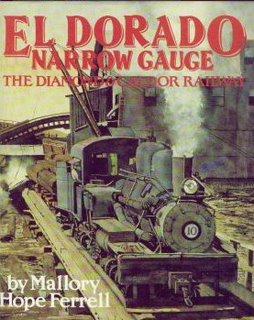 I think the high price of gasoline has infected the world of railroad booksellers. Only the seller missed the message that the per barrel cost has dropped significantly.
Unfortunately, the seller of the latest copy of El Dorado Narrow Gauge, the quintessential text on the Diamond and Caldor Railway, may be able to demand such an exorbitant sale price.
Last year we tracked two copies of the copy of the Mallory Hope Ferrell classic that sold for $110 and $130 each on eBay.com.
This copy appeared today on eBay. The seller is using the "Buy it Now" feature to sell the book.
He's asking $175. Like the inflated gas prices of last summer, this is a take-it-or-leave-it sale.
If you want the book, you must pay at the pump or wait for the price to come down. Of course, you risk loosing the book, a rare piece in the world of short line railroads.
The on-line sale ends November 13, 2008, unless a collector buys it before that date.
It's difficult to predict how high the book will go. It wouldn't surprise me if someone pumps out the full price.
Sunday, October 12, 2008
Machining the valve links
Here are two photographs from last summer:
 Machinist Alberto Weiss aligns the milling head over one of the valve links to the Diamond and Caldor No. 4 Shay locomotive. Here he uses the indicator on the second hole to tell him when the head is aligned over the hole.
At the moment I took the picture, Alberto was five-thousands of an inch off center.
"Now I have the center," said Alberto. To center, he moved the milling machine table "this way" (Alberto motioned side-to-side) and "that way" (front-to-back) until the tool was centered.
Alberto then removed the indicator and inserted the carbide boring tool. He set a towel on top of the valve linkage incase he dropped the heavy tool.
The tool is too valuable (and expensive) to risk breaking it. "This is the only one we have."
Alberto usually makes four or five passes with the boring tool for each hole. This hole only required three passes.
"Until I see the tool doesn't touch any more," explained Alberto. "Then I stop."
Alberto's goal was to make all six holes (two per valve link) equal in diameter.
 "That's fantastic," exclaimed Alberto. "I expected serious problems."
"In the top it hardly took nothing," explained Alberto. "In the bottom the chips were really big."
Sometimes a simple task, like boring out the holes on the valve linkage, goes completely right in the machine shop. It's always a cause for celebration.
The last thing you want to do, said EDWRF president Keith Berry, is to patch up a major blunder, or worst, re-cast the part.
This is the part that tells the locomotive to go this way (pointing forward) or that way (pointing backward) on the first stroke of the engine, said Keith. The first stroke determines which way the steam engine will go.
After that, the engine moves in the direction it was set to go.
"Isn't it amazing that this piece was made 21 years before you were born!" Keith said to Albert.
 Machinist Alberto Weiss aligns the milling head over one of the valve links to the Diamond and Caldor No. 4 Shay locomotive. Here he uses the indicator on the second hole to tell him when the head is aligned over the hole.
At the moment I took the picture, Alberto was five-thousands of an inch off center.
"Now I have the center," said Alberto. To center, he moved the milling machine table "this way" (Alberto motioned side-to-side) and "that way" (front-to-back) until the tool was centered.
Alberto then removed the indicator and inserted the carbide boring tool. He set a towel on top of the valve linkage incase he dropped the heavy tool.
The tool is too valuable (and expensive) to risk breaking it. "This is the only one we have."
Alberto usually makes four or five passes with the boring tool for each hole. This hole only required three passes.
"Until I see the tool doesn't touch any more," explained Alberto. "Then I stop."
Alberto's goal was to make all six holes (two per valve link) equal in diameter.
 "That's fantastic," exclaimed Alberto. "I expected serious problems."
"In the top it hardly took nothing," explained Alberto. "In the bottom the chips were really big."
Sometimes a simple task, like boring out the holes on the valve linkage, goes completely right in the machine shop. It's always a cause for celebration.
The last thing you want to do, said EDWRF president Keith Berry, is to patch up a major blunder, or worst, re-cast the part.
This is the part that tells the locomotive to go this way (pointing forward) or that way (pointing backward) on the first stroke of the engine, said Keith. The first stroke determines which way the steam engine will go.
After that, the engine moves in the direction it was set to go.
"Isn't it amazing that this piece was made 21 years before you were born!" Keith said to Albert.
Saturday, October 11, 2008
Southern Pacific No. 9

Even though I've neglected the blog for the past month, the crew has been busy working behind the scenes. And we've had time to visit two California railroad museums.
After our a photographic tour of the Bodie State Historic Park last Saturday, Keith and I (and our wives) drove to Bishop on Sunday to visit the Laws Railroad Museum in Laws, California. The museum is located about five miles north of Bishop on U.S. Highway 6.
The museum was built right on the right-of-way of the old Carson and Colorado Railroad, later acquired by the Southern Pacific. The narrow gauge railroad ran from Carson City, Nevada south to Keeler, California from 1880 to 1960. It never reached the Colorado River as implied by the name. It was one of the last narrow gauge lines to operate in the west.
Here's what one Southern Pacific Narrow Gauge website has to say about the No. 9 (known as the Slim Princess):
Locomotive No. 9, a 4-6-0, was built by the Baldwin Locomotive Works, November 1909 for the Nevada-Calif.-Oregon Railway as their No. 9. It was acquired by the Southern Pacific Railroad, September 1, 1929, rebuilt and put in service on the Owens Valley line Feb. 21 1930 as the S P No. 9. It was put on stand-by service when the diesel electric locomotive was put in service, Oct. 1954, was retired when the railroad was abandoned. The locomotive was donated to the City of Bishop and moved to Laws for display, April 30, 1960.
Subscribe to:
Posts (Atom)