This history was prepared by Robert Niles for the Eldorado National Forest in 1979. This segment concludes our reprint of serialized portions of Mr. Nile’s report.
The company prospered through the post World War II building era, but it became obvious that changing times and depleted timber holdings would soon force some important changes in operating policies. In 1952 a directive from the State Safety Commission ordered immediate instillation automatic couplers on the Diamond and Caldor railroad cars to replace the original link and pin coupling system.
Mr. Price and company directors calculated the cost of updating the equipment and faced with increasing maintenance cost of old trestles, road bed and locomotives decided to abandon the railroad. Diesel trucks would now be utilized for the entire log haul from woods landings to the mill at Diamond Springs.
Track crews were retained to take up the rails and this progressed from Caldor to Diamond Springs. Most of the remaining engines and obsolete equipment were brought in from Caldor and sold to a South San Francisco scrap dealer, Oscar Borovik. Abandonment of the line was completed in the spring of 1953.
A cutover timber land exchange with the U.S. Forest Service in 1952 for timber stumpage in the Caldor working circle sustained the mill operation for a few more years. The company then experimented with importing mahogany logs from the Philippines. These were shipped into a bay area port then loaded onto Southern Pacific Railroad gondola cars for delivers to Diamond Springs.
The sawmill and remaining cutover land were sold to Winton Lumber Company in 1956, who operated the facility on a limited basis for a short time. The entire mill operation at Diamond Springs were abandoned when the Winton Lumber organization sold their extensive timber holdings and facilities to American Forest Products Corp. in June 1964.
Showing posts with label California Door Company. Show all posts
Showing posts with label California Door Company. Show all posts
Monday, October 26, 2009


Monday, October 12, 2009
History of the California Door Company and its logging railroads #12
This history was prepared by Robert Niles for the Eldorado National Forest in 1979. The El Dorado Western Railway blog will reprint serialized portions of Mr. Nile’s report in the coming months.
The old mill site at Caldor now became a division point and logging camp as the extensive housing and track layouts were utilized. Daily operations on the Diamond and Caldor started with a 20-car log train departing from Caldor before daybreak.
Moving past Leoni Station it made its way down to the halfway point at Rodwell (Coles Station) where there was a turning wye, sidings for 40 cars, oil and water facilities. Here the training was broken into two sections and the engines that had brought up the empties from Diamond Springs hooked up the loaded log cars and returned.
The Caldor engines then picked up 20 empty cars spotted at the Rodwell siding and returned to the logging areas. Mean while another train crew was busy making up another string of loaded cars for the next days run from Caldor.
The average daily train delivered about 150,000 board-feet of logs to the mill. The round trip from Diamond Springs to Caldor took about 16 hours including the activities at Rodwell.
Editor’s note: Rodwell and Coles Station are not located at the same point. Rodwell was situated in the North Fork Consumnes River canyon at the 15-mile post. Coles was located on the ridge to the south at the 21-mile post.
Conversion from wood to oil was accomplished in 1910. The engines used for switching and logging continued to burn wood until the early 1920’s, as did the donkey engines in the woods. As the donkeys were continually on the move from one cutting and loading area to another, facilities for oil storage were not practical in the early years.
The renewal of logging activities in 1935 saw many changes taking place in the logging industry. The diesel, internal combustion engine powering crawler type tractors began to replace the steam donkeys for skidding logs to the landings and diesel powered jammers and cranes took the job of loading the log cars.
The biggest transformation, however, was in the form of the diesel logging truck for transporting logs and would soon spell an end to the logging railroad era. Old railroad grades were converted to a truck haul transportation system and the numerous trestles were bypassed and abandoned as the ravines were filled in.
1945 marked the end of most railroad logging for the California Door Company, and some of the wood locomotives began to be broken up for scrap. The more mobile diesel log trucks now supplied practically all the logs to the transfer point at Camp Webster and Caldor where they were reloaded on to the log cars for the 33 mile rail haul to Diamond Springs.
Monday, September 28, 2009
History of the California Door Company and its logging railroads #11
This history was prepared by Robert Niles for the Eldorado National Forest in 1979. The El Dorado Western Railway blog will reprint serialized portions of Mr. Nile’s report in the coming months.
From the time the sawmill was established in 1902, and with the creation of the logging railroad to supply its raw material needs, the lumber operation expanded and prospered. Extensive bachelor living quarters, family houses, shop, mess hall, store and community hall were built up surrounding the mill at Caldor. Close to 200 people, including the families of the mill workers were now living there.
The mill and logging operations shut down in the wintertime due to the heavy snows and most of the people moved into Diamond Springs for the winter months. For several families, however, this was their only home and they stayed there year round after having put aside up to a six month supply of food staples.
On August 13, 1923 a disastrous fire completely destroyed the sawmill at Caldor, bringing to a close its twenty odd years of operation. After an analysis of the damage and overall efficiency of the operation, it was decided by the board of directors to build a new sawmill at Diamond Springs.
Construction was soon underway and a new larger, electrically powered mill was completed in 1924. During this time the mail line railroad from Caldor was extensively repaired and rehabilitated and a new 65-ton, 3-truck Shay was ordered to supplement the existing locomotives.
Engine facilities near the new mill site were expanded and the D&C mainline from Caldor was made ready to covert it to hauling logs instead of sawn lumber. Facilities at the new mill included a log pond that could accommodate 2-1/2-million board-feet of logs.
For the next five years the nation-wide building boom and good times placed a heavy demand on the woods and sawmill operation. In 1929 the Wall Street Stock Market crash occurred and the failing national economy forced the closing of the Diamond Springs mill the following winter. The logging and mainline locomotives and rolling stock were brought into Diamond Springs and placed in storage. Lumber for a curtailed operation at the Oakland door plan was once again obtained on the open market.
In 1934 the California Door Company acquired the services of Mr. Chalmers Price, a highly-qualified lumberman, and instructed him to start up the logging and sawmill operations at Diamond Springs and Caldor. Extensive rehabilitation of the mill and D&C Railway to Caldor was necessary as the five years of inactivity had taken their toll. The D&C mainline was realigned at some locations and shortened slightly to 33 miles. In the springs of 1935 logging and sawmilling operations were again underway.
Wednesday, September 16, 2009
History of the California Door Company and its logging railroads #10
This history was prepared by Robert Niles for the Eldorado National Forest in 1979. The El Dorado Western Railway blog will reprint serialized portions of Mr. Nile’s report in the coming months.
Later on, bunk railroad cars for living quarters and commissary were built up in the D&C shops at Diamond Springs and these gradually replaced the portable frame camp buildings for the logging and construction crews. These provided more comfortable living quarters and were easily moved to new logging locations, and spotted on to an adjacent siding.
It is therefore reasonable to presume that any substantial amount of physical evidence still identifiable as a logging camp existing along the old railroad line was established between 1904 and 1915, during the first ten years or so of the railroad operation. Examination of the surviving area maps of the time verify some of these camp locations.
Some of these early camps became switching or division points on the logging railroad system and were used for many years, while others were abandoned when logging was completed in their area. Some of these abandoned camps were probably utilized later on by ranchers and others in the area.
The early logging crews were probably quartered at Caldor mill facility previous to 1904, as logging operations were limited to adjacent timber stands. The early skid roads were confined to McKinney Creek and Dogtown Creek drainages and then extended north and eastward along Plummer Ridge.
With the beginning of railroad logging in 1904, camps to accommodate the crews were established as the railroad logging system developed and moved farther away from the mill.
There is no record or recollections concerning the numbering of the railroad logging camps. Such a procedure was generally used on a typical railroad logging show of the time.
Discussions with "old timers" acquainted with the early operations indicate the camps were identified by names only. A hypothetical numbering system has been devised to facilitate identification and locations of known camps in conjunction with applicable names.
There were undoubtedly several other logging camps established in conjunction with the railroad logging activities. Many of these were most likely temporary and transient in nature and were served by bunk cars or portable houses. Most probably there was a camp and division point at Pi Pi and at Five Corners, as these were key points on the railroad system.
Movable logging camps were undoubtedly used in the Bear Meadow Loop area during extensive logging here in the 1930's. Subsequent relogging activities, road building and camp activities have pretty well obliterated what few remnants may have survived from these temporary camps.
Saturday, November 29, 2008
History of the California Door Company and its logging railroads #9
This history was prepared by Robert Niles for the Eldorado National Forest in 1979. The El Dorado Western Railway blog will reprint serialized portions of Mr. Nile’s report in the coming months.
The camps were established at various locations along the railroad logging line to accommodate the logging and construction crews close to their work. None of the woods crew were quartered at the Caldor Sawmill complex while it operated up until 1923. They stayed out all week in the bachelor camps and came to Caldor only on the weekends.
Life in the logging camps was primitive, but after a long day of hard physical work there was little time or thought given to recreation. The men were kept well fed with a high protein diet of fresh beef sent in from the slaughterhouse at Caldor.
Consumption of various alcoholic beverages was undoubtedly considerable. The main recreation experience, as time allowed, was fishing for trout in the abundantly stocked rivers and streams adjacent to the logging camps.
The first camps that were established apparently were of a more permanent nature that in later years. Horses and mules were being used extensively for skidding operations as the steam donkey had not yet entirely out their use. The care of the animals, therefore, necessitated the building of stables and corrals, and so a more durable camp complex developed.
Rough sawn lumber was furnished from the sawmill, and the cook house, living quarters, smithy, stables, barns and out buildings were constructed, generally contingent to a spring or other adequate water supply.
By 1915 the transition from animals to steam donkeys for log yarding and skidding needs had pretty well taken place, and the logging camps took on a much more temporary and transient nature.
Wood framed buildings were fabricated at the Caldor mill and were made up of rough, board and batten construction. These were about 8’x16’ in size and would accommodate four men. These buildings could be cross hauled by steam donkeys on to log bunk cars and moved from camp to camp as the scene of logging operations shifted.
Monday, November 17, 2008
Diamond Springs mill
 A 14-year old Richard Wright snapped this photograph of the abandoned Diamond Springs mill site in April 1968. At that point, the mill had been closed for four years.
Today, the planing mill is used to store RVs, boats and other vehicles. It's located at the corner of Missouri Flat Road and Industrial Drive. What was once considered Diamond Springs sits on the Zip Code boarder between Placerville and Diamond Springs.
Saturday, November 15, 2008
History of the California Door Company and its logging railroads #8
This history was prepared by Robert Niles for the Eldorado National Forest in 1979. The El Dorado Western Railway blog will reprint serialized portions of Mr. Nile’s report in the coming months.
The rail logging spurs progressed outward along the drainages with grade changes being held as low as possible, but could run up to as high as eight percent for short distances when necessary. The spur road beds were not ballasted as they were considered only temporary in nature and final grading and construction were left to minimal requirements to support the engines and loaded cars.
Rail ties and trestle timbers were provided from the Caldor Mill and most certainly represented a substantial board foot volume of lumber production. After all the accessible timber adjacent to the spur lines were logged out, the rails were removed for reuse on other spurs.
All the logging rails were narrow gauge, three-foot width, to coordinate rolling stock with the rest of the Diamond and Caldor railroad system. Manpower was the predominant factor in placing rails and building trestles and the use of crowbars, sledges, shovels, crosscut saws and jacks were much in evidence.
Few records were kept of the logging rail system and it would probably be easier to trace these spurs through the overgrown country side than to locate or rely on any tangible records. An examination of old maps, cutover charts and actual on-the-ground observation and knowledge, however, gives one a pretty accurate account of the location of the entire system.
Logging camp locations and their approximate dates of use were also gleaned from these few remaining charts and maps. Firsthand knowledge, interviews and observation of physical evidence of known campsites were also relied of for some camp locations.
Saturday, November 01, 2008
History of the California Door Company and its logging railroads #7
This history was prepared by Robert Niles for the Eldorado National Forest in 1979. The El Dorado Western Railway blog will reprint serialized portions of Mr. Nile’s report in the coming months.
The geared locomotive was originally designed and patented by an enterprising Michigan lumberman named Ephriam Shay in 1881. Shay recognized the need for a small, powerful locomotive that could be used to transport logs over steep grades, poor road beds and tight radius curves to the sawmills.
The existing rod driven locomotives were limited to gentle grades and required well ballasted road beds to withstand the pounding shock of the drive wheels, and thus were limited to well maintained, permanent mainline hauls.
The Lima Locomotive Works began manufacturing the first crude, two-truck Shay geared engines on the Shay patent and by 1888 had sold 200 to the lumber industry. At this time the Climax Manufacturing Company of Corry, Pennsylvania, brought out their Climax geared locomotive and in 1894 Charles Heisler in Erie, Pennsylvania, produced the Heisler geared locomotive.
Shay’s head start, its rugged performance and improved models, however, put it well a head of its competition. The Lima Locomotive Works produced 2,761 geared Shay locomotives until it ended their production in 1945, and the argument over which was the best geared locomotive had been won decisively by the Shay.
The Diamond and Caldor Railroad utilized 9 Shay locomotives and the one Baldwin 2-4-2T Saddle Tank Rod Locomotive at various times during their 50 years of railroad operations.
The transition to railroad logging progressed rapidly after 1904 with construction of logging spurs extending from Caldor northwest into the Steely Forks and south and east into the Middle Fork of the Consumnes River drainages.
Road alignments were laid out and construction crews brought the road beds to grade with horse drawn “Fresno” scrapers. Black powder was utilized for blasting loose stumps and rock formations. Because fill material volume was difficult to obtain, extensive use of trestles were used to cross even minor drainages.
Sunday, September 07, 2008
History of the California Door Company and its logging railroads #6
This history was prepared by Robert Niles for the Eldorado National Forest in 1979. The El Dorado Western Railway blog will reprint serialized portions of Mr. Nile’s report in the coming months.
The Dolbeer steam donkey was developed in 1882 by John Dolbeer of Eureka, California. With this development the chore of handling logs became considerably easier.
The Dolbeer donkey was a simple devise utilizing a small, upright steam engine to power a single drum winch. The devise was first used for unloading logs at the mill, but was soon it was put to use pulling logs to the landings in the woods and unloading logs by cross haul cables and "gin" poles on to the log cars. More powerful engines were developed later to operate double drum winches for increased pulling power.
The versatile Dolbeer donkey was also utilized by attaching it to the pilot of a locomotive. This combination of log handling machinery and locomotive was dubbed a "gypsy." There is no evidence that such a devise was ever used by the Caldor operation, but extensive use was made of the skid mounted Dolbeer donkey in the woods and at the saw mill.
These steam winches began the phase out of the dependence on horses and mules for log skidding and loading after 1900.
With the arrival of the steel rail and steam locomotives at Caldor in 1904, the transition to a railroad logging operation began. The timber stands owned by the California Door Company were of excellent quality and could average up to 35,000 board feet per acre on the well-stocked sites.
The new mill could produce up to 60,000 board feet of timber per day so the stage was set for a more efficient harvest of the timber stands by utilizing the new geared locomotives that were now being used in the Sierra Nevada and were to drastically change production and logging methods in the timer industry.
I'll post the next installment in two weeks ...
Sunday, August 24, 2008
History of the California Door Company and its logging railroads #5
This history was prepared by Robert Niles for the Eldorado National Forest in 1979. The El Dorado Western Railway blog will reprint serialized portions of Mr. Nile’s report in the coming months.
After the California Door company acquired the small mill and timber holdings in 1900 the company brought in mules and horses and the new Dolbeer steam donkeys to move the logs to the mill pond.
Michigan lumbermen had already devised the high wheels or "Michigan log buggy" (one is exhibited at the El Dorado County Historical Museum) that was the forerunner of the logging arch. This devise raised the front end of the log clear of the ground to decrease the skidding friction. The "Michigan log buggies" were also used at Caldor during logging operations before railroad logging came into existence.
Pole roads had also been devised in the Michigan woods in an early effort to get the logs off the ground. These were crude pole "railroads" on which double flanged or concave wheeled cars, loaded with logs, were pulled by horses, oxen, steam tractors or donkey engines.
Pole roads were used in some isolated locations in the west, but the size and weight of the large pine logs in the Sierra Nevada and the lack of a braking system to control the cars speed, probably precluded their use here. There is no evidence that a system of pole roads were utilized at any time during logging operations in the Caldor area.
Flumes and log chutes were also utilized for log and lumber transportation, but were of a very limited and specialized nature in the Sierra Nevada. A log chute was used by the American River Land and Lumber Company at Slab Creek on the American River in 1891.
The Madera Sugar Pine Lumber Company utilized an elaborate flume system to transport their sawn lumber from the mill south of Yosemite to their mill at Madera. Log chutes may have been used on a limited basis during the early logging days around Caldor, but no records or physical evidence of chutes or flumes is known to exist.
I'll post the next installment in two weeks ...
Monday, August 11, 2008
History of the California Door Company and its logging railroads #4
The small mill operation that existed before the California Door Company acquired it and its timber holdings in 1900 was typical of the many small, independent mills operating in the Sierra Nevada at the time. They came into existence to furnish lumber locally to the flourishing gold mining industry and communities of the 1850s and the nearby cattle and dairy ranchers.
Logging methods were primitive from the 1850s to 1890s and ox teams were relied on to skid the logs short distances to the saw mills. These rudimentary methods were dictated by the very nature of the Sierra Nevada.
In comparison, the abundant rivers and waterways in British Columbia and Washington provided ready transportation of logs, and so large, high production sawmills evolved. Logging there progressed up and along these waterways and logs were skidded directly to the rivers by ox teams or directed to flumes and chutes which carried them to the rivers and down to the mills.
The Sierra Nevada’s river drainage systems are steep and rough with low water volumes in the summertime and early attempts to drive logs down them resulted in failure. The lack of river transportation, therefore, limited early sawmilling operations to small local mill until rail transportation evolved in the 1890s.
As the nearby timber stands were depleted the logging operations were extended farther from the mill. The slow moving but durable oxen were used almost exclusively in these operations until they were generally replaced by the more easily handled horse and mules in the 1890s.
As the skid roads became overused and extended further from the mill they were reinforced with crossed logs on which skidded logs were pulled. The ends of the logs were rounded off or "snubbed" and cross bridging greased to ease their progress.
Heavy four wheeled log wagons were brought into use and logs were loaded on to them with a cross haul jerk line method. Main wagon roads thus developed out from the mill following the easier contours and terrain of the countryside and started development of a transportation system.
Probably all of the logging to the original mill at Dogtown was done with oxen either skidding the logs or pulling the heavy wagons.
I'll post the next installment in two weeks ...
Saturday, July 12, 2008
History of the California Door Company and its logging railroads #3
This history was prepared by Robert Niles for the Eldorado National Forest in 1979. The El Dorado Western Railway blog will reprint serialized portions of Mr. Nile’s report in the coming months.
The railroad was to be a three-foot, narrow gauge and would be 34.69 miles long. Construction progressed rapidly as the D&C was financed by a sound and prosperous company. Ties and bridge timbers were sawn out at the Caldor Mill and the track work advanced westward from Caldor to Diamond Springs.
A total of 63 trestles with a combined length of 10,992 feet were required to traverse the difficult terrain. A steel bridge structure 97 feet long was built to cross the North Fork of the Comsumnes River and was one of the longest ever built for a logging railroad up to the time.
Ties and trestle timbers were delivered to the work crews with the steam tractor and the work progressed rapidly. The Diamond and Caldor Railway line was completed in October 1904 after 18 months of construction and a cost of $388,788.00.
The first locomotive to see service was a Baldwin saddle tank 2-4-2T built in 1887 and purchased used from the Ferries and Cliff House Railway (their #3). At the same time locomotive #2, a Lima two-truck Shay #863 was purchased new and put into service.
Rolling stock was equipped with link and pin couplings standard for the times and which would eventually be the deciding factor in the termination of the railroad some 50 years later.
I'll post the next installment in two weeks ...
Saturday, June 21, 2008
History of the California Door Company and its logging railroads #2
This history was prepared by Robert Niles for the Eldorado National Forest in 1979. The El Dorado Western Railway blog will reprint serialized portions of Mr. Nile’s report in the coming months.
A new, modern sawmill was constructed and the locale was renamed “Caldor.” Mr. Anton Hassler, Sr., was designated as the new mills superintendent. He had emigrated from Germany and was working for the California Door Company, which at that time had a contract to manufacture and install sash and doors during an expansion and remodeling project at San Quentin Prison at San Rafael. He moved to Caldor as superintendent in 1902 when the new sawmill was completed.
The new mill was unique in that the log pond, supplied by water from Dogtown Creek, was elevated above the operating floor of the mill, allowing the floated logs to be lowered by gravity down the log chute to the mill floor for placing on the log carriage. The sawn lumber was then transported to Diamond Springs where a new planing mill has been constructed. Rail service from the Diamond Springs mill was available via the Central Pacific (Southern Pacific) Railroad to the Oakland sash and door plant.
The sawn lumber from Caldor Mill was first transported to Diamond Springs on lumber wagons drawn by mule teams. This was a slow and difficult task. Oxen were then tried for a time to see if they could improve on the situation, but they provided no appreciable advantage. The progressive company then brought in chain driven steam tractors to do the hauling job in 1901. A review of the situation made it apparent, however, that a railroad would be the only reasonable solution to the transportation problem.
A railroad route was surveyed in 1901 and a wholly owned subsidiary of the California Door Company, the Diamond and Caldor Railway, was incorporated as a common carrier in 1902. Officers of the railroad were W.Y Kellog, President; C.W. Doe, Vice President; F.A. Merquire, Secretary; E.H. Kitteredge, Treasurer; and W.I. Wilson, General Manager.
I'll post the next installment in two weeks ...
Saturday, May 31, 2008
Caldor Mill engine house
 A 1916 shot of the engine house at the Caldor Mill. If you carefully gaze at the original photograph you’ll see three Diamond and Calor Railway locomotives.
Unless noted, historic photographs in the El Dorado Western blog are from the collection of the El Dorado County Historical Museum. These photographs are available for $10 each from the museum. Call (530) 621-5865 for additional information. Please consult museum staff for limitations to the use of photographs.
History of the California Door Company and its logging railroads
This history was prepared by Robert Niles for the Eldorado National Forest in 1979. The El Dorado Western Railway blog will reprint serialized portions of Mr. Nile’s report in the coming months.
Forward
The following account of the California Door Company and its years of logging and sawmilling in El Dorado County has been put together from a wide variety of sources and information.
Hopefully, this report will give a better understanding of the way of life of those times, and the extent of past impacts imposed on the area by the railroad logging and the men who left their transitory mark.
By Robert Niles
Placerville, California
1979
History of the California Door Company and its logging railroads
The California Door Company was formed in 1884 with the merger of three sash, door and millwork companies doing business in the San Francisco Bay Area.
Mr. Bartlett Doe was the first person on the scene in 1849 acting as agent for a Boston, Massachusetts sash and door company that was shipping manufactured millwork products to San Francisco merchants.
Mr. Doe was the possibility for establishing a manufacturing business of his own, an in 1850 entered into a wood working partnership with his brother John. This established the B.&J.S. Doe Company located at 36 Market Street in San Francisco.
The following year a competing business was formed by George and Nat Wilson to merchandize doors, window frames and millwork.
In 1861 Charles S. Doe, a brother of Bartlett and John, acquired an existing millwork company operating in San Francisco.
These companies grew and thrived with the prosperity of the times.
In 1884 the Doe brothers merged their business with George and Nat Wilson’s to establish the California Door Company. A new manufacturing plant was established in Oakland to produce doors, windows and blinds and was recognized as the largest plant of its kind in the west.
To assure an adequate and dependable supply of sugar pine and Ponderosa pine lumber for their new sash and door plant, the California Door Company in 1900, acquired some 30,000 acres of timberland in El Dorado County. A small sawmill was included and was located some 30 miles southeast of Diamond Springs at a gold mining settlement known as Dogtown in the Consumnes River Drainage.
I'll post the next installment in two weeks ...
Thursday, January 18, 2007
Trestles on the Steely Fork Branch Line
Once the rails of the Diamond & Caldor Railway reached Caldor, some 34 rail miles east of Diamond Springs, three main feeder lines fanned to the north, east and south of the mill. The California Door Company used these lines to haul the freshly cut logs to its mill each day during the six to seven month logging season.
One of these feeder lines is still viable in the Eldorado National Forest several miles east of Grizzly Flat. The Steely Fork line ran northwest from the mill. At its northern most limit, it reached Bear Meadow.
The narrow-gauge expansion began in 1907. The line encompassed some 50 miles of logging spurs. The line allowed the company to log along North and South Steely creeks to Capps Crossing on the North Fork of the Consumnes River. The line reached Long Canyon and Bear Meadow to the west.
 The Steely Fork line heads to the west as it climbs out of the Steely Fork canyon. This cut is found a hundred feet west of the ruins of the river trestle. The Steely Fork trestle crossed the river just west of the confluence of the North and South Steely creeks.
 One of the few trestle bents that's remains upright. All four trestles collapsed years ago. Today the heavy timbers are slowly rotting.
 The first trestle can be reached after a 10 minute hike from the Trestle Trail trail head. It's still possible to see some organization to the heavy bridge timbers on the ground. I was able to count a dozen or more bents at this trestle site. Most of the timbers (10x10 or larger) are in very good condition considering it's been 54 years since abandonment.
 Bridge timbers are lined up on the ground between the eastern and western landings. This picture looks to the east.
Cross-posted at 'Round the Chuckbox blog.
One of these feeder lines is still viable in the Eldorado National Forest several miles east of Grizzly Flat. The Steely Fork line ran northwest from the mill. At its northern most limit, it reached Bear Meadow.
The narrow-gauge expansion began in 1907. The line encompassed some 50 miles of logging spurs. The line allowed the company to log along North and South Steely creeks to Capps Crossing on the North Fork of the Consumnes River. The line reached Long Canyon and Bear Meadow to the west.
The Steely Fork line heads to the west as it climbs out of the Steely Fork canyon. This cut is found a hundred feet west of the ruins of the river trestle. The Steely Fork trestle crossed the river just west of the confluence of the North and South Steely creeks. One of the few trestle bents that's remains upright. All four trestles collapsed years ago. Today the heavy timbers are slowly rotting. The first trestle can be reached after a 10 minute hike from the Trestle Trail trail head. It's still possible to see some organization to the heavy bridge timbers on the ground. I was able to count a dozen or more bents at this trestle site. Most of the timbers (10x10 or larger) are in very good condition considering it's been 54 years since abandonment.Bridge timbers are lined up on the ground between the eastern and western landings. This picture looks to the east.Cross-posted at 'Round the Chuckbox blog.
Sunday, January 07, 2007
Trestle Trail
This afternoon I took advantage of a light snow pack in the old logging area of the California Door Company. I've been looking for a weekend where I could survey the Trestle Trail in Eldorado National Forest east of the community of Grizzly Flat.
Very little evidence of the Diamond & Caldor Railway and its parent company, California Door Company, remain in the forest. Trestle Trail is a hiking trail that travels along one of the logging company's main feeder lines north of Caldor.
Here are three photos of our hike:
Here's what the Eldorado National Forest website has to say about the trail:
Very little evidence of the Diamond & Caldor Railway and its parent company, California Door Company, remain in the forest. Trestle Trail is a hiking trail that travels along one of the logging company's main feeder lines north of Caldor.
Here are three photos of our hike:
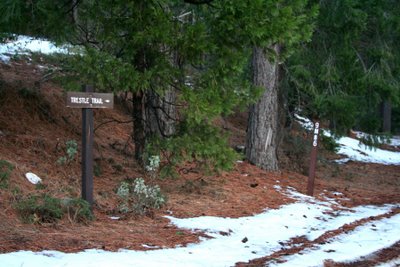 To access Trestle Trail, take Capps Crossing Road from Grizzly Flat to Forest Road 9N86. Continue east along the road for a half mile. Turn right onto Road 9N86A. An abandoned vehicle about three-tenths of a mile down the road partially blocks the road.
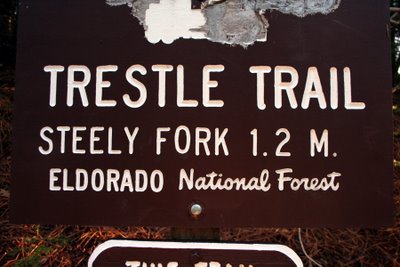 After you drive another half mile (or so -- I didn't clock it), you'll see this sign to the left up on the old railroad grade. Park your car in the wide spot and hike the trail.
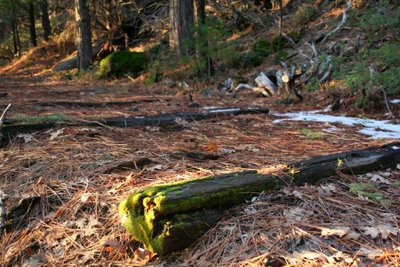
Partially buried railroad ties are visible a few hundred feet from the trail head. Please don't disturb the ties.
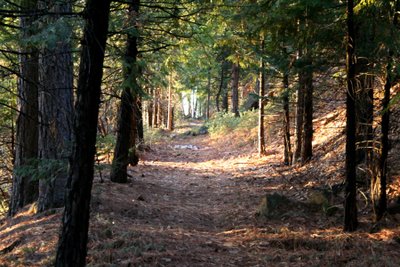
Here's what the Eldorado National Forest website has to say about the trail:
Trestle Trail: Follow the Capps Crossing Road from Grizzly Flat or the North South Road (Forest Route 6) to the dirt road 9N36. Turn south on this road and stay to the right for approximately one-half mile to the trailhead. This pleasant foot trail follows a railroad grade for 1.2 miles to the site of the main bridge (removed) over Steely Fork Creek. The trail is in excellent condition, and passes three collapsed trestles (wooden railroad bridges) on the steep hillside. Return to the trailhead along the same route.
Subscribe to:
Posts (Atom)